- GDP growth (IMF, Oct)
- Around 4% this year; about 3% on average over the medium term
- Inflation
- 2.95% average Jan–Sep 2026 (Ministry of Economy); IMF expects ~3%
- Fiscal balance
- Surplus of about 5% of GDP this year and next (IMF)
- FDI stock
- RO 32.21 billion at end-Q2 2026, up 6.4%
- Free zones & SEZs
- RO 22.4 billion total investment, up 6.8% (OPAZ)
Oman's economy is having a strong year. The IMF's latest projections, reported on 2 November 2026, put growth at around 4% this year, inflation at about 3% and the fiscal surplus at roughly 5% of GDP this year and next, while the Ministry of Economy reports real GDP up 3.8% and the foreign direct investment (FDI) stock up 6.4% to RO 32.21 billion by mid-2026. For founders and investors, that means a stable, well-funded economy with low inflation and growing non-oil exports, which is a good backdrop for registering a company in Oman, provided you plan for rising costs and choose the right location.
This guide sets out the latest figures, explains what is driving them, and turns them into practical decisions about structure, location, budget and timing.
The latest numbers at a glance
Three sets of figures were published in the first days of November 2026: the IMF's October projections (presented in Muscat by the IMF mission), the Ministry of Economy's October 2026 Economics Brief, and international press coverage of how the regional conflict is affecting Oman.
| Indicator | Latest figure | Source |
|---|---|---|
| GDP growth, this year | Around 4% (IMF, October projections) | Oman Observer, 2 Nov 2026 |
| Medium-term growth | About 3% a year on average | Oman Observer, 2 Nov 2026 |
| Real GDP, end-Q2 2026 | RO 19.54 billion, up 3.8% | Ministry of Economy via Oman Observer, 1 Nov 2026 |
| Oil activities | RO 6.45 billion, up 9.7% | Ministry of Economy |
| Non-oil activities | RO 13.92 billion, up 1.3% | Ministry of Economy |
| Inflation | 2.95% average, Jan–Sep 2026; IMF expects ~3% | Ministry of Economy; IMF |
| Fiscal balance | Surplus of about 5% of GDP this year and next | IMF |
| FDI stock, end-Q2 2026 | RO 32.21 billion, up 6.4% | Ministry of Economy |
| FDI inflows, Q2 2026 | RO 1.93 billion, down 43.7% year on year | Ministry of Economy |
| Non-oil exports | RO 4.88 billion, up 10.5% | Ministry of Economy |
| Omani crude price | Average $82.6 a barrel to end-September, up 14.7% | Ministry of Economy |
| Free zone & SEZ investment | RO 22.4 billion, up 6.8% | OPAZ, April 2026 |
The forecasts have moved up during the year. In April, the IMF's World Economic Outlook expected 3.5% growth and inflation of about 1.7% for Oman in 2026, with public debt falling to around 33% of GDP. By October, both growth and inflation forecasts were higher.
What is driving growth
Oil output and prices. The IMF links this year's stronger growth to higher oil production, with Oman planning to raise output towards a capacity of 1.2 million barrels per day. Omani crude averaged $82.6 a barrel to the end of September. Oil activities grew 9.7% in the first half, and higher revenues are what turned the budget into a surplus.
A safer route for trade. International coverage on 3 November described Oman as "fairly shielded from the worst of attacks" in the regional conflict and noted that its southern ports lie outside the Strait of Hormuz. That has drawn businesses looking for alternative trade routes. One example cited: CMA CGM and Oman's Asyad Group signed a $400 million agreement to develop a logistics terminal at Sohar port.
Industrial investment in the zones. OPAZ reported that total investment in Oman's free zones and economic zones reached RO 22.4 billion, up 6.8%. In April 2026 alone it signed new industrial projects worth over RO 200 million, including a RO 41 million steel mould plant in Duqm and a RO 35 million EV battery-materials plant in Salalah Free Zone, where cumulative investment in active projects has reached about RO 4.5 billion. In late October, OPAZ signed a further 28 investment agreements across Madayn cities, free zones and Duqm.
Stronger public finances. Public debt has almost halved from pandemic-era highs of 68% of GDP to around 35%, and sovereign credit ratings are back at investment grade. A government with surpluses pays its contractors on time, keeps investing in infrastructure and has less need to raise taxes in a hurry, all of which matters to private companies.
The weak spots investors should not ignore
A balanced reading of the data shows three things to watch:
- Non-oil growth is slower. Non-oil activities grew just 1.3% in the first half, far slower than oil. Demand in some local consumer and service sectors may be softer than the headline figure suggests, so test your market before you scale.
- FDI inflows dropped in Q2. The stock of FDI grew, but quarterly inflows fell 43.7% year on year to RO 1.93 billion. Flows are volatile from quarter to quarter, but the drop is a reminder that big projects move slowly.
- Costs are rising. Inflation averaged 2.95% to September, well above the 1.7% forecast in April. The chairman of the Oman Economic Association said the figure "did not fully reflect the pressures facing businesses". Budget conservatively for rent, freight, materials and salaries.
The IMF also highlighted four policy priorities: reducing the state's role in the economy, improving liquidity management, managing fiscal surpluses and building infrastructure that can withstand natural disasters. A smaller state role points to more private-sector opportunities through privatisation and partnerships over time.
What the outlook means for your company setup
Macroeconomics only helps if it changes a decision. Here is how the current picture translates into practical choices.
1. Choose the location by your market, not the headline. If you are exporting, re-exporting or serving supply chains diverted by the conflict, the free zones (Sohar, Salalah, Duqm and others) offer customs advantages and, for new enterprises under Royal Decree 38/2025, a 10-year tax exemption. If you sell mainly to Omani customers or bid for government contracts, a mainland company is usually the better fit. Factories that need land and utilities should also compare the Madayn industrial cities.
2. Pick the right legal form. Most foreign investors use an LLC, and a single owner can use a sole proprietor company (SPC). Under the Foreign Capital Investment Law (Royal Decree 50/2019), 100% foreign ownership is allowed in most activities, except the 123 activities reserved for Omanis. Our company types guide compares them.
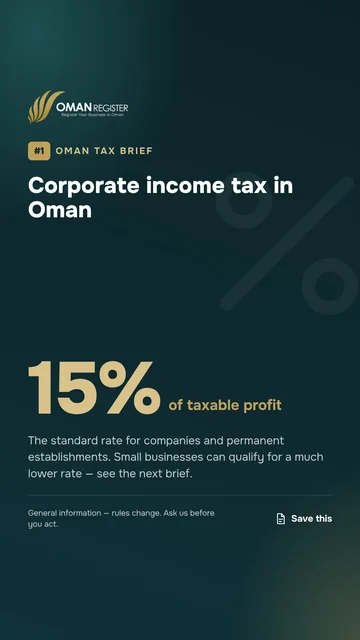
3. Plan your tax position early. A growing, surplus economy does not mean no tax. Corporate income tax is 15% (3% for qualifying small companies with capital up to OMR 60,000, income up to OMR 150,000 and no more than 25 staff), VAT is 5%, and personal income tax of 5% on income above OMR 42,000 starts in 2028 under Royal Decree 56/2025. E-invoicing becomes mandatory in phases from 2027.
4. Budget for inflation and Omanisation. Build at least a 3% annual cost increase into your plan, and include the cost of hiring Omanis to meet your sector's Omanisation targets, which also affects how many expatriate work permits you can get.
5. Think about residency together with the company. Owning a company gives you a route to an investor residence card. Larger investors can use Oman's Golden Residency, which starts from OMR 200,000 and gives 10-year residency through seven routes.
Sectors with momentum
Based on the published figures and recent deals, these sectors have the clearest tailwinds:
| Sector | Why now | Typical setup |
|---|---|---|
| Logistics, shipping, freight forwarding | Ports outside the Strait of Hormuz; $400m Sohar terminal deal | Free zone or mainland LLC |
| Manufacturing and building materials | RO 22.4bn invested in zones; new Duqm and Khazaen projects | Free zone, SEZ or industrial city |
| EV and battery materials | RO 35m anode materials plant in Salalah Free Zone | Free zone |
| Data centres and digital services | Proposed large-scale AI data centre in Salalah | Mainland or zone, activity-specific licence |
| Export trading (non-oil goods) | Non-oil exports up 10.5% to RO 4.88bn | Mainland LLC or free zone |
| Services to industry (engineering, maintenance, HSE) | Steady project pipeline backed by fiscal surplus | Mainland LLC |
Check the list of business activities to confirm your activity is open to foreign ownership and which approvals it needs.
Common mistakes when reading the "boom" headlines
- Treating oil-led growth as consumer demand. Most of this year's acceleration comes from oil. Check demand in your specific segment.
- Waiting for the "perfect" moment. Registration, licences, bank account and visas take weeks to months. Investors who set up during a strong cycle are ready when contracts appear.
- Ignoring zone conditions. Free zone tax holidays have conditions, and selling into the mainland can trigger customs duty.
- Under-budgeting. Inflation forecasts nearly doubled between April and October. Leave a buffer.
- Relying on a single forecast. Different sources quote slightly different growth numbers. Plan around a range, not one figure.
How Oman Register can help
Oman Register helps investors turn a good market moment into a working company: choosing between mainland, free zone and industrial city, registering an LLC or SPC, licences, bank account, investor residency and Golden Residency applications. Final approvals are always decided by the competent authorities, but a well-prepared file saves weeks.
Call or WhatsApp +968 7733 3556, email info@omanregister.com, or contact us to discuss your project.
Frequently asked questions
How fast is Oman's economy growing?
The IMF's October projections, reported by Oman Observer on 2 November 2026, put Oman's growth at around 4% this year, supported by higher oil production and resilient non-oil activity, with medium-term growth averaging about 3%. The Ministry of Economy reported real GDP up 3.8% to RO 19.54 billion at the end of the second quarter of 2026.
Is Oman a good place to start a business right now?
The macro picture is supportive: growth around 4%, low inflation, fiscal surpluses, public debt far below pandemic levels and investment-grade credit ratings. Whether it suits your business depends on your market, activity and costs, so test demand and run a budget before committing. The authorities decide every licence and approval.
What is the inflation rate in Oman?
Oman's Ministry of Economy reported average inflation of 2.95% for January–September 2026, and the IMF expects inflation to average around 3% this year. That is higher than the IMF's April forecast of about 1.7%, so budget for some cost increases.
How much foreign direct investment does Oman have?
According to the Ministry of Economy's October 2026 brief, the FDI stock rose 6.4% to RO 32.21 billion by the end of the second quarter of 2026. Inflows in that quarter were RO 1.93 billion, 43.7% lower than in the same period a year earlier.
Does the regional conflict make Oman riskier for investors?
Every investor should weigh it. Coverage in November 2026 described Oman as fairly shielded from the worst of the attacks and noted that its southern ports sit outside the Strait of Hormuz, which has drawn interest from companies looking for alternative trade routes. Higher oil prices have also strengthened public finances. Insurance, supply routes and contingency plans still deserve attention.
Which sectors benefit most from Oman's current outlook?
Recent figures point to logistics and ports, manufacturing in the free zones and industrial cities, EV and battery materials, data centres and services linked to non-oil exports, which rose 10.5% to RO 4.88 billion. Oil-related activity also grew strongly, by 9.7%, while non-oil GDP grew 1.3%.
Sources & official references
- Oman Observer — IMF sees Oman economy growing 4% in 2026 (2 Nov 2026)
- Oman Observer — Oman's economic indicators point to continued growth (1 Nov 2026)
- Yahoo Finance (Moby) — Oman Wants to Turn War Profits into Long-term Economic Gains (3 Nov 2026)
- OPAZ — New industrial projects worth RO 200 million in free zones and economic zones (26 Apr 2026)
- Ministry of Foreign Affairs of Oman — IMF predicts strong economic outlook for Oman (19 Apr 2026)
- AGBI — Oman's economy needs a steady hand as war drags on (2026)
This guide is general information, checked against official sources at the date shown. Rules and fees in Oman change; we confirm the current requirements for your case before you apply.

Need help setting up in Oman?
Tell us what you plan to do. We will recommend the right location and company type, list the documents and quote the full cost before you start.
Related guides

Best Business Ideas in Oman for Foreign Investors
Eight business ideas that match where Oman's government money, growth targets and incentives are pointing right now, with the latest official figures, where to set each one up and the rules foreign owners must check first.

From Muscat to Duqm: The 5 Best Cities to Invest in Oman
A practical comparison of Muscat, Sohar, Salalah, Duqm and the Khazaen/Barka corridor as investment locations in Oman, with the zones, sectors and incentives each offers.

Investment Opportunities in Oman Free Zones: Strategic Roadmap
A roadmap to investment opportunities in Oman's free zones and special economic zones: which sectors each zone targets, the incentives under the new zones law, and how to choose and enter.