Good books in Oman do three jobs. They support your tax returns, they pass the auditor's review, and they show you each month how the business is actually doing. Oman Register keeps your books under IFRS, runs payroll through the Wage Protection System and social protection filings, and sends you clear monthly reports, so year-end is a formality rather than a fire drill.
What the law expects from your books
Oman applies full IFRS. Oman has not adopted the IFRS for SMEs standard, and most SMEs already use full IFRS. For income tax, the authority expects accounts prepared under IFRS or a similar standard it approves, on an accruals basis and in local currency unless it allows otherwise.
Key compliance points our bookkeeping is built around:
- Annual income tax return. Due within four months of the financial year-end and generally filed with accounts audited by an auditor registered in Oman. SMEs taxed at 3% file within three months, using a simplified income statement. See our guide to Oman's tax landscape.
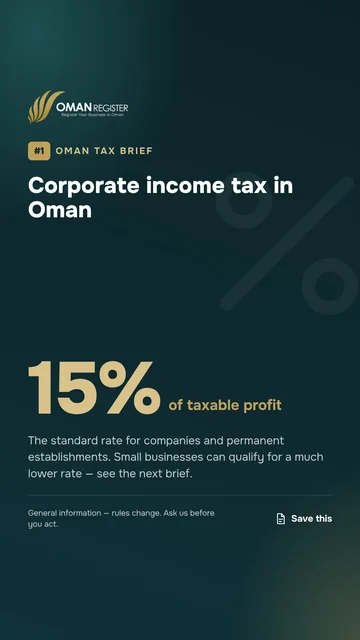
- Rates. Corporate income tax is 15%, or 3% for Omani proprietorships and LLCs with capital of up to OMR 60,000, gross income of up to OMR 150,000 and an average of no more than 25 employees, excluding certain sectors.
- Late filing. A late or missed income tax return can draw a penalty of OMR 100 to OMR 2,000, and late tax accrues 1% a month.
- Record retention. Accounting records and supporting documents must be kept for ten years. VAT records, including every tax invoice issued and received, must also be kept for ten years.
- VAT. If you are registered, your ledgers must produce quarterly VAT returns and keep every tax invoice. See VAT registration and filing.
Payroll, WPS and social protection
Payroll is where Oman's rules are tightest, and where mistakes now hold up hiring.
Wage Protection System. Ministerial Decision 729/2024, in force since 16 December 2024, requires wages to reach employees' accounts within three days of the end of the wage period. Payment must go through banks or financial institutions regulated by the Central Bank of Oman. The Ministry of Labour phased in minimum coverage: at least 75% of the workforce had to be paid through WPS from September 2025 salaries, rising to 90% from November 2025 salaries. If you fall behind, the Ministry can issue a warning, suspend the issue of preliminary work permits, and fine OMR 50 per worker, with the fine doubled for repeat violations.
Social Protection Fund. The Social Protection Law (Royal Decree 52/2023) brought pensions and insurance branches together under the Social Protection Fund. Omani employees carry employer and employee contributions across several branches. Employers also pay a 1% maternity and paternity contribution for foreign workers. A savings scheme for expatriates is scheduled for 2027. It is funded by 9% of basic salary and is expected to replace end-of-service gratuity for future service. Because these rules are being phased in, we check the current rates and ceilings before every payroll run.
For hiring and work permits, see our work permit guide.
Our monthly service, step by step
| When | What we do | What you receive |
|---|---|---|
| Onboarding | Set up a chart of accounts, opening balances, accounting software access and document flow | A bookkeeping manual and a document checklist |
| Weekly / ongoing | Record sales, purchases, expenses, bank and card transactions | Up-to-date ledgers |
| Before payday | Calculate payroll, allowances, deductions and SPF contributions; prepare the WPS salary file | Payslips and a bank-ready WPS file |
| Month-end | Bank reconciliations, accruals, prepayments, fixed assets, VAT coding | Trial balance |
| By day 10–15 | Management pack | P&L, balance sheet, cash flow, receivables and payables ageing |
| Quarterly | VAT return workings, if registered | Return ready for review and filing |
| Year-end | IFRS financial statements and audit file | Audit-ready accounts for our licensed audit partners |
Reporting days are our service standard. Government deadlines are set by the authorities and listed above.
Documents we need from you
- Commercial registration, articles of association and VAT/tax registration details
- Bank statements and online banking read access
- Sales invoices, purchase invoices, receipts and contracts
- Employee list with contracts, salaries, allowances and SPF registration details
- Fixed asset register and loan agreements
- Prior-year financial statements and the auditor's report, if any
Common mistakes we fix
- Mixing personal and company spending. Common in owner-managed LLCs, and painful at audit.
- Paying salaries in cash or outside WPS. This risks fines and a freeze on new work permits.
- No accruals. Cash-basis books do not meet IFRS and distort monthly profit.
- Missing tax invoices. Without a valid tax invoice, input VAT is hard to support.
- Leaving it all to year-end. Reconstructing a year of transactions costs more than monthly bookkeeping, and it delays the audit and the tax return.
Who this is for
Our clients are mostly foreign-owned LLCs, branches and free-zone companies, often run by founders who are not based in Oman full time. Many also need figures for people outside the company: banks reviewing credit facilities, investors and the Ministry of Commerce, Industry and Investment Promotion. In January 2025 the ministry launched a Financial Reports Service on the Oman Business Platform for submitting annual financial data electronically. We prepare those figures from the same ledgers as your tax return, so every number agrees. If you are still setting up, start with company registration in Oman, and we will have your books ready from day one.
We quote a fixed monthly fee after a short call, based on transaction volume and headcount. Contact us on +968 7733 3556 or info@omanregister.com.
Frequently asked questions
Which accounting standards apply to companies in Oman?
Companies in Oman prepare financial statements under full IFRS. Oman has not adopted the IFRS for SMEs standard, and the tax authority expects accounts prepared under IFRS or a similar standard it approves, on an accruals basis.
How long must I keep accounting records?
Ten years. Income tax rules require accounting records and supporting documents to be kept for ten years after the end of the accounting period, and VAT records are also kept for ten years (longer in some cases, such as real estate).
What is the Wage Protection System?
WPS is the Ministry of Labour's system for monitoring private-sector salaries. Under Ministerial Decision 729/2024, wages must be paid into employees' accounts at banks or financial institutions regulated by the Central Bank of Oman within three days of the end of the wage period.
What happens if salaries are paid late under WPS?
The Ministry can issue a warning, suspend the issue of new work permits until the violation is fixed, and fine OMR 50 per worker, with fines doubled for repeat violations. Late salaries can therefore hold up your hiring as well as cost money.
Do I pay social protection contributions for expatriate staff?
Yes, for some branches. Under the Social Protection Law (Royal Decree 52/2023), employers pay a 1% maternity and paternity leave contribution for foreign workers as well as Omanis. A savings scheme for expatriate workers, funded by 9% of basic salary and expected to replace end-of-service gratuity for future service, is scheduled for 2027. We confirm the current rates every payroll month.
Do I still need an auditor if you keep my books?
Usually yes. The annual income tax return is generally filed with accounts audited by an auditor registered in Oman, with relaxed rules for SMEs taxed at 3%. We prepare audit-ready books and work with our licensed audit partners for the statutory audit.
Sources & official references
- PwC Worldwide Tax Summaries — Oman: Corporate tax administration
- KPMG Oman — Ministry of Labour updates to the Wage Protection System
- Oman Observer — MoL sets new wage transfer compliance deadlines
- IFRS Foundation — Jurisdiction profile: Oman
- Gulf News — Oman to introduce mandatory savings scheme for expatriate workers from 2027
- PwC Worldwide Tax Summaries — Oman: Other taxes (VAT and social security)
- Oman Observer — New services to enhance Oman's competitiveness
This guide is general information, checked against official sources at the date shown. Rules and fees in Oman change; we confirm the current requirements for your case before you apply.



Need help setting up in Oman?
Tell us what you plan to do. We will recommend the right location and company type, list the documents and quote the full cost before you start.