- Legal basis
- Tax Authority Decisions 223, 224 and 225/2026 (Gazette 1667, 27 Sep 2026)
- In force
- 1 October 2026
- Food items at 0%
- 807 (Decision 225/2026)
- Medical items at 0%
- 677 (Decision 224/2026, MoH release permit)
- Veterinary items at 0%
- 62 (Decision 223/2026, MAFWR release permit)
- Repealed
- Decisions 59/2021 and 65/2021
Since 1 October 2026, Oman applies 0% VAT to 1,546 listed products: 807 food items, 677 medical items and 62 veterinary products. The lists come from Oman Tax Authority Decisions 223, 224 and 225 of 2026, published in Official Gazette No. 1667 on 27 September 2026, and they replace the zero-rate lists from 2021. Shoppers pay no VAT on these goods, and the businesses that sell them must make sure every product is coded correctly.
For supermarkets, food importers, pharmacies, clinics, medical-equipment traders and veterinary suppliers, this is not a one-line change. The new annexes identify goods by 12-digit customs tariff code, medical and veterinary items need a ministry release permit, and the old lists no longer count. This guide explains what is covered, what the conditions are, and what to do if you run — or plan to register a company in Oman — in these sectors.
The three decisions at a glance
The Tax Authority issued all three decisions on 22 September 2026 under the VAT Law (Royal Decree 121/2020). According to PwC and VATupdate, they work as follows:
| Decision | What it covers | Items at 0% | Condition | Replaces |
|---|---|---|---|---|
| 225/2026 | Food commodities | 807 | Product must be on the list | Decision 65/2021 |
| 224/2026 | Human medicines, medical preparations and medical equipment | 677 | On the list and Ministry of Health release permit under the customs code | Decision 59/2021 |
| 223/2026 | Veterinary medicines and medical equipment | 62 | On the list and Ministry of Agriculture, Fisheries and Water Resources release permit | New list |
| Total | 1,546 |
Every annex lists products by 12-digit customs tariff code together with a product description. PwC notes that Decisions 59/2021 and 65/2021 are repealed, so from 1 October 2026 the 2026 annexes are the only reference. For scale: when VAT started in Oman in April 2021, the Oman Observer reported 488 zero-rated food items. The food list now has 807.
The Tax Authority described the move as a step towards developing the tax system to meet the needs of society. The Oman Observer linked it to easing household budgets at a time of higher food prices.
What is on the food list
Decision 225/2026 covers the basic food basket. PwC, VATupdate and the Oman Observer list these groups:
- Live animals — cattle, sheep, goats, camels and poultry for breeding, slaughter or milk
- Meat and poultry — fresh, chilled, frozen and minced
- Fish and seafood — including shrimp and squid
- Dairy — milk, yoghurt, labneh, butter and cheese
- Eggs — table and hatching eggs
- Fruit, vegetables and dates — fresh and dried, plus legumes
- Grains and flour, edible oils, sugar and table salt
- Infant food, ordinary bread and drinking water
- Coffee, tea, spices and seasonings
- Animal feed and certain inputs for food production
Food that is not on the list — for example many processed, packaged or prepared products — stays at the standard 5% rate. The only safe test is the annex itself: find the product's tariff code and check that the description matches.
A practical tip for retailers: the same shelf can hold both rates. A basic product may be at 0% while a processed product made from it sits next to it at 5%, depending on whether its tariff code and description appear in the annex. Build the rate into the product record, not into the shelf or category, and train cashiers and buyers to flag new items before they go on sale.
Medicines, medical equipment and veterinary products
Decision 224/2026 covers 677 items: medicines, herbal medicines, biological and health preparations, foods for special medical purposes and medical equipment. PwC gives examples such as vaccines, infant formula, diagnostic equipment, wheelchairs, hearing aids and hospital beds. The Oman Observer adds oxygen, dental products and smoking-cessation patches and sprays.
Decision 223/2026 covers 62 veterinary items, including vaccines, antisera, antibiotics, hormones, vitamins, minerals and amino acids, and veterinary testing products.
The key difference from the food list is the permit condition. A medical product is zero-rated only if it is on the list and the Ministry of Health has issued a release permit under its customs code. Veterinary products need a permit from the Ministry of Agriculture, Fisheries and Water Resources. Lookuptax stresses that products without that clearance do not qualify automatically — so pharmacies and distributors should keep the permit trail for every SKU they sell at 0%.
Zero-rated is not the same as exempt
This distinction decides your cash flow. PwC's Oman tax summary explains it:
| Zero-rated (0%) | Exempt | |
|---|---|---|
| VAT charged to the customer | 0% | None |
| Seller can recover input VAT on its costs | Yes | No |
| Counts towards the VAT registration threshold | Yes | No |
| Examples in Oman | Listed basic food, listed medicines, exports, international transport | Certain financial services, local passenger transport, education, residential rent |
Because zero-rated sales are still taxable supplies, a grocery or pharmacy business that sells mostly 0% goods but pays 5% VAT on rent, equipment, fit-out and services can end up in a refund position. PwC notes that where recoverable input VAT exceeds output VAT, a refund may be possible, subject to the legal requirements and Tax Authority review.
What businesses should do now
PwC and VATupdate recommend the same core steps. If you have not finished them, the risk is real: charging 0% on an item that does not qualify means underpaid VAT, penalties and interest; charging 5% on an item that does qualify means corrective invoices and amended returns.
- Map your product master data against the new 12-digit tariff codes and descriptions. Do not assume a product that was 0% under the 2021 lists is still 0%.
- Collect release permits for every medical and veterinary product you sell at 0%.
- Update ERP, POS, invoicing and e-commerce systems so the right rate applies to supplies from 1 October 2026.
- Check VAT return mapping so zero-rated sales are reported correctly in the next quarterly return. Returns and payment are due within 30 days after the end of each quarter.
- Review past invoices since 1 October and correct any wrong rates.
- Set a control for new products — every new SKU or tariff-code change should be checked against the annexes before it goes on sale.
- Plan for e-invoicing. Correct tax codes will matter even more once Fawtara e-invoicing becomes mandatory in 2027, because every invoice will be reported to the Tax Authority.
What this means if you are starting a business in Oman
The new lists make food trading, food processing, livestock, pharmacies, medical supply and veterinary distribution more attractive for consumers — and they set clear rules from day one for new companies in these sectors. Points to plan for when you set up:
- Choose the right activities. Food trading, pharmacy and medical-equipment trading each need the correct activity codes and, for health products, Ministry of Health licensing. See our guide to business activities in Oman.
- Register for VAT at the right time. Registration is mandatory once annual taxable supplies exceed OMR 38,500 and voluntary from OMR 19,250. A new importer that pays VAT at customs and on fit-out may benefit from registering voluntarily to recover it.
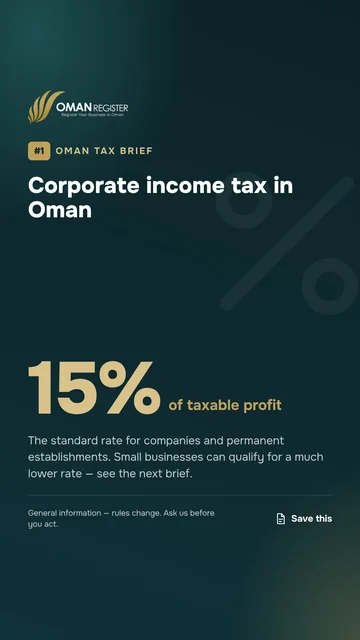
- Budget for the other taxes. Corporate income tax is 15%, or 3% for qualifying small companies (capital up to OMR 60,000, income up to OMR 150,000, up to 25 staff). Our Oman tax guide for investors covers the full picture.
- Pick a structure that fits. Most traders use a limited liability company (LLC); importers focused on re-export often compare mainland with free zones.
Tax treatment of individual products is decided by the Oman Tax Authority under the published annexes. If you are unsure how a product line is treated, check the official decision text or ask a tax adviser before you price it.
Oman Register helps investors register companies, choose activities and get VAT-ready from the start. Call or WhatsApp +968 7733 3556, email info@omanregister.com, or contact us for a free first consultation.
Frequently asked questions
Which items are zero-rated for VAT in Oman?
From 1 October 2026, three Tax Authority decisions set the lists: 807 food items (Decision 225/2026), 677 medicines, medical preparations and medical equipment (Decision 224/2026) and 62 veterinary medicines and equipment (Decision 223/2026). Each item is identified by a 12-digit customs tariff code and description in the annex to the decision.
Is fresh food VAT-free in Oman?
Most basic food is taxed at 0%. Decision 225/2026 covers live animals, meat and poultry, fish and seafood, dairy and cheese, eggs, fruit and vegetables, dates, grains, flour and legumes, edible oils, sugar, infant food, ordinary bread, drinking water, table salt and animal feed. Food that is not on the list stays at the standard 5% rate.
Are medicines zero-rated in Oman?
Yes, if the product is on the Decision 224/2026 list and the Ministry of Health has issued the required release permit under its customs code. Veterinary products follow the same logic under Decision 223/2026, with the permit issued by the Ministry of Agriculture, Fisheries and Water Resources.
Does zero-rated mean the same as VAT-exempt?
No. A zero-rated supply is taxable at 0%, so the seller can still recover the VAT it pays on its own costs. An exempt supply, such as local passenger transport or residential rent, carries no VAT and the seller cannot recover input VAT.
Can a company that sells mostly zero-rated goods get a VAT refund?
Possibly. If the input VAT a company can recover is higher than the VAT it charges, the difference may be refunded, subject to the legal conditions and review by the Oman Tax Authority. The company must be VAT-registered to claim it.
Do I need to register for VAT if I only sell zero-rated food?
VAT registration is mandatory when annual taxable supplies exceed OMR 38,500, and zero-rated sales count as taxable supplies. Voluntary registration is possible from OMR 19,250, which can make sense for businesses that want to recover input VAT.
Sources & official references
- PwC Middle East — Oman updates zero-rated VAT lists for food, medicines and veterinary products (Oct 2026)
- PwC Middle East — Oman VAT rate update, tax news alert (PDF, Oct 2026)
- Khaleej Times — Oman adds 807 food items, 677 medical items, 62 vet products to zero-VAT list (27 Sep 2026)
- Oman Observer — Oman expands zero-rated VAT list to 807 food items (27 Sep 2026)
- Oman Observer — Oman expands zero-rated VAT goods from October (27 Sep 2026)
- VATupdate — Oman expands VAT zero-rating for food, medicines and medical equipment (16 Oct 2026)
- PwC Worldwide Tax Summaries — Oman: Other taxes (VAT)
- Lookuptax — Oman VAT zero-rate Decisions 223–225/2026
This guide is general information, checked against official sources at the date shown. Rules and fees in Oman change; we confirm the current requirements for your case before you apply.

Need help setting up in Oman?
Tell us what you plan to do. We will recommend the right location and company type, list the documents and quote the full cost before you start.
Related guides

How to Open a Corporate Bank Account in Oman
Every company registered in Oman must bank in its own name with a licensed Omani bank. This guide walks through the documents, the beneficial-owner (UBO) checks, typical balance requirements and fees, and how to get your file approved without delays.

Best Business Ideas in Oman for Foreign Investors
Eight business ideas that match where Oman's government money, growth targets and incentives are pointing right now, with the latest official figures, where to set each one up and the rules foreign owners must check first.

Hidden Trade in Oman: Rules, Fines and the Legal Way Out
Running a business through someone else's name or commercial registration is hidden trade (tasattur) under Ministerial Decision 412/2023. Here is what the rule says, how the national inspection drive works, the penalties and how to restructure legally.