- Instrument
- OPAZ Decision 81/2026 (Executive Regulations of RD 38/2025)
- In force
- 21 September 2026 (published in the Official Gazette 20 Sep)
- Licence decision
- 7 working days for a complete application; silence counts as approval
- Strategic project
- Investment of at least OMR 10 million + one qualitative criterion
- Income tax holiday
- 10 years, renewable twice for 'special nature' activities
- Residency
- Investors, property owners, spouses and first-degree relatives (subject to conditions)
Oman's free zone executive regulations — issued by the Public Authority for Special Economic Zones and Free Zones (OPAZ) as Decision 81/2026 — are now the rulebook for every company in Duqm, Sohar, Salalah, Al Mazunah, Khazaen and the other zones. They took effect on 21 September 2026 and bring three big changes for investors: licences decided in seven working days through one digital window, a new strategic project track for investments of OMR 10 million or more, and a clear list of activities that can extend the 10-year income tax holiday.
The regulations implement the Special Economic Zones and Free Zones Law (Royal Decree 38/2025). Since publication, tax advisers and the local press have been unpacking them chapter by chapter, and in November new residency and property questions are pushing them back into the headlines. Below is a practical summary of what has changed and what it means if you are planning a company in an Omani zone.
What Decision 81/2026 is and when it applies
The Law of Special Economic Zones and Free Zones replaced the separate regimes that used to govern each zone with one framework under OPAZ. The law set the principles; the executive regulations fill in the procedures. According to PwC, Decision 81/2026 was published in the Official Gazette on 20 September 2026 and became effective on 21 September 2026.
OPAZ's official spokesperson, Dr Saeed bin Khalifa Al Qurini, told Oman Daily that the regulations turn the law into executive procedures covering land allocation, licences, operation, services, incentives, exemptions, obligations, oversight and compliance. In practice, they touch every stage of an investor's life in a zone — from the first land request to annual reporting.
One structural point matters for day-to-day dealings: free zone operators and special economic zone bodies get wider executive powers to complete investor transactions and provide services, while OPAZ keeps the regulatory and supervisory role. For most companies, the zone operator remains the counter they deal with.
Licensing: one window, seven working days
The One-Stop Shop is now the principal channel for all investor services: land and property allocation, licences, approvals, permits and certificates. Zone operators must link their electronic systems to it in real time, with electronic payment and integration with government data.
The key changes for applicants:
- Seven working days — a complete licence application must be decided within seven working days. If no answer is given in that time, the application is treated as approved.
- Automatic issue — a licence can be issued automatically once automated checks confirm the data, documents and conditions.
- Automatic renewal — business licences renew automatically as long as the company's information is up to date and the conditions are still met.
- Reasons and grievances — rejections must be reasoned, and there is a grievance route in specified cases.
The regulations also ask more of applicants up front. A land allocation request must come with a feasibility study covering the nature of the project, investment size, financing sources and implementation schedule, plus evidence of financial capacity. OPAZ keeps an integrated investment register recording each project's activities, capital expenditure, employment, land, licences and incentives. Investors must report actual investment spending, financing sources, operating performance, workforce composition and Omanisation levels.
If you are choosing between zones, our free zones overview and the Duqm vs Sohar vs Salalah comparison explain how each one is positioned.
Strategic projects: OMR 10 million and one extra criterion
Chapter Seven of the regulations creates a fast track for large investments. Under Article 37, a project can qualify as strategic if it invests at least OMR 10 million and meets at least one of these qualitative criteria:
- technology and knowledge transfer;
- local content;
- self-sufficiency or economic security;
- export development.
The project must also fall within the fields set by the OPAZ Board, and the Board may waive the OMR 10 million minimum where a project's nature or strategic importance justifies it. A strategic project can obtain a single approval covering establishment, operation and management.
Under Article 39, strategic projects may receive, with Council of Ministers approval on the Board's recommendation:
| Incentive for strategic projects | Limit set by the regulations |
|---|---|
| Exemption from land/property rent or usufruct payments | Up to 10 years from the start of operations |
| Exception from prescribed Omanisation percentages | Up to 4 years |
| Exemption from applicable fees | Full or partial |
| Other project-specific incentives | As approved |
The four-year Omanisation exception is notable: in the early years, when a plant is being built and commissioned, hiring targets are often the hardest obligation to meet.
Tax holidays: who can extend the 10 years
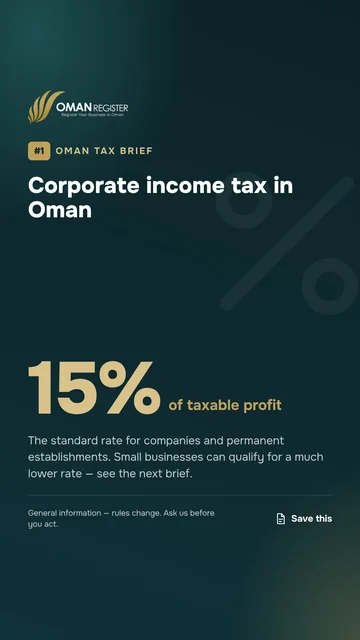
New enterprises in the zones can receive a 10-year income tax exemption under the law. According to EY, that exemption can be renewed twice for activities of a "special nature", subject to the approval of the Minister of Finance and to conditions and exclusions. Outside the exemption, Oman's standard corporate income tax rate is 15%.
Article 41 of the regulations lists the special-nature categories:
| # | Activity category |
|---|---|
| 1 | Heavy manufacturing, including petrochemicals, minerals and basic metals |
| 2 | Green industries, renewable energy, green hydrogen and its derivatives |
| 3 | Logistics and port handling |
| 4 | Advanced technology, data centres, artificial intelligence and innovation |
| 5 | Strategic infrastructure |
| 6 | Food security projects |
| 7 | Pharmaceutical, medical, biotechnology and recycling |
| 8 | Administrative offices, commercial representation, import/export and similar activities that add value to the national economy |
| 9 | Service providers whose contracts have at least 15 months left when the exemption is requested |
| 10 | Any other project the OPAZ Board considers of economic or strategic added value |
Category 8 is worth noting for trading and regional-office set-ups, which are among the most common free zone companies. Category 9 matters for contractors serving large projects in Duqm or Sohar.
An exemption is not a holiday from paperwork. Article 43 requires exempt companies to keep proper accounts audited by a licensed auditor, file tax returns under the Income Tax Law and give OPAZ their financial statements on request. Companies that belong to large multinational groups should also check how a tax holiday interacts with the Oman top-up tax.
Two further operating points from the regulations: companies can export directly or through third parties without separate export permission, subject to reporting; and OPAZ can carry out monitoring and inspections and apply administrative penalties, with an emphasis on letting companies correct non-compliance first.
Freehold property and residency inside the zones
The regulations add a full chapter on real estate development. The main points:
- Freehold for non-Omanis — foreigners may acquire freehold ownership of units in qualifying real estate projects inside the economic zones. The qualifying criteria are set by the authorities; not every project or area qualifies.
- Off-plan sales — developers must meet financial and technical requirements before marketing or advertising units off-plan.
- Escrow — withdrawals from project escrow accounts are controlled so buyers' money is used for its intended purpose.
- Residency — non-Omani investors and property owners, together with their spouses and first-degree relatives, can obtain residency, subject to the applicable conditions and legislation.
The regulations do not publish a separate investment threshold or permit duration for this zone route. Investors who want a long-term permit not tied to employment should also look at the Golden Residency programme, which starts from OMR 200,000 for a 10-year permit, and at the sponsor-free property owner residence permit on the mainland.
What this means for your company set-up
| If you are… | What to do now |
|---|---|
| Starting a trading or regional-office company | Check whether your activity fits Article 41, category 8, before you apply for the tax exemption |
| Planning a factory or plant above OMR 10 million | Prepare the qualitative case (technology, local content, food security or exports) and ask about strategic status and the single approval |
| Applying for land | Have a feasibility study, financing plan, schedule and proof of financial capacity ready from day one |
| Already licensed in a zone | Keep your data current on the One-Stop Shop so automatic renewal works, and prepare for reporting on spending, staff and Omanisation |
| Buying property in a zone | Confirm the project is qualifying for freehold and that the developer uses an escrow account |
Common mistakes we see: applying with an incomplete file (the seven-day clock only starts once the application is complete), assuming a free zone tax holiday removes the need for audited accounts, and choosing a zone before checking which activities and incentives it actually offers. The authorities decide every licence, exemption and residency application; good preparation shortens the path but does not replace their approval.
For companies weighing a zone against the mainland, see mainland company registration and the list of business activities. If you want help choosing a zone and preparing the application, contact Oman Register on +968 7733 3556 or info@omanregister.com.
Frequently asked questions
What are Oman's free zone executive regulations?
They are the implementing rules of the Special Economic Zones and Free Zones Law (Royal Decree 38/2025), issued by the Public Authority for Special Economic Zones and Free Zones (OPAZ) as Decision 81/2026. According to PwC they were published in the Official Gazette on 20 September 2026 and took effect on 21 September 2026. They cover licensing, land allocation, incentives, tax exemptions, compliance and real estate development.
How long does it take to get a free zone licence in Oman now?
Under the regulations, a complete licence application must be decided within seven working days, and if the authority does not respond within that period the application is treated as approved. Licences can also be issued automatically through the One-Stop Shop once automated checks confirm the data, documents and conditions.
What counts as a strategic project?
A project with an investment of at least OMR 10 million that also meets at least one qualitative criterion: technology and knowledge transfer, local content, self-sufficiency or economic security, or export development, in a field set by the OPAZ Board. The Board may waive the OMR 10 million minimum when a project's nature or strategic importance justifies it.
Can the 10-year tax exemption in an Omani free zone be extended?
Yes, for activities of a 'special nature'. According to EY, the law allows the 10-year income tax exemption to be renewed twice, with the approval of the Minister of Finance. Article 41 of the regulations lists the qualifying categories, such as heavy manufacturing, green hydrogen, logistics, data centres and AI, food security and pharmaceuticals.
Can foreigners own property and get residency in Oman's economic zones?
The regulations allow non-Omanis to acquire freehold ownership of units in qualifying real estate projects inside the zones, and provide residency for non-Omani investors and property owners together with their spouses and first-degree relatives, subject to the applicable conditions and legislation. The detailed qualifying criteria are set by the authorities.
Does a free zone company still have to file tax returns during the exemption?
Yes. Article 43 requires exempt projects to keep proper accounts audited by a licensed auditor, file tax returns under the Income Tax Law and give OPAZ their financial statements on request.
Sources & official references
- PwC Middle East — New Executive Regulations shape the future of Oman's Special Economic Zones and Free Zones (28 Sep 2026)
- EY Tax News — Oman issues Executive Regulations for Special Economic Zones and Free Zones Law (22 Oct 2026)
- Oman Observer — Tax exemptions for industries in Oman zones (18 Oct 2026)
- Oman Observer — Economic zones sharpen focus on local content (22 Oct 2026)
- Oman Daily — The executive regulation of the SEZ and Free Zones Law marks a new phase for the investment environment (Arabic, 4 Oct 2026)
- Arabian Business — Oman issues new free zone rules for foreign property ownership, residency and business licences (21 Sep 2026)
- Gulf News — Oman rolls out new investment rules for special economic and free zones (20 Sep 2026)
This guide is general information, checked against official sources at the date shown. Rules and fees in Oman change; we confirm the current requirements for your case before you apply.

Need help setting up in Oman?
Tell us what you plan to do. We will recommend the right location and company type, list the documents and quote the full cost before you start.
Related guides

Oman Signs OMR 304m in Zone Deals: What It Means for Investors
On 28 October 2026 Oman signed 28 investment agreements worth more than OMR 304 million across its industrial cities, free zones and the Duqm SEZ. Here is where the money went, which sectors are winning, and what it means if you plan to set up in one of these zones.

Why Sohar Free Zone Is a Top Investment Destination in Oman
An investor's look at why Sohar Freezone is one of Oman's leading investment locations: port connectivity, incentives, sectors, realistic limitations and who it suits best.

Khazaen Free Zone: A Strategic Investment Hub in Oman
What investors need to know about Khazaen Free Zone inside Khazaen Economic City in Barka: location and logistics links, incentives under Royal Decree 38/2025, suitable activities, the setup process and cost components.